Best Realtors in Kansas City: What to Look for Before Choosing
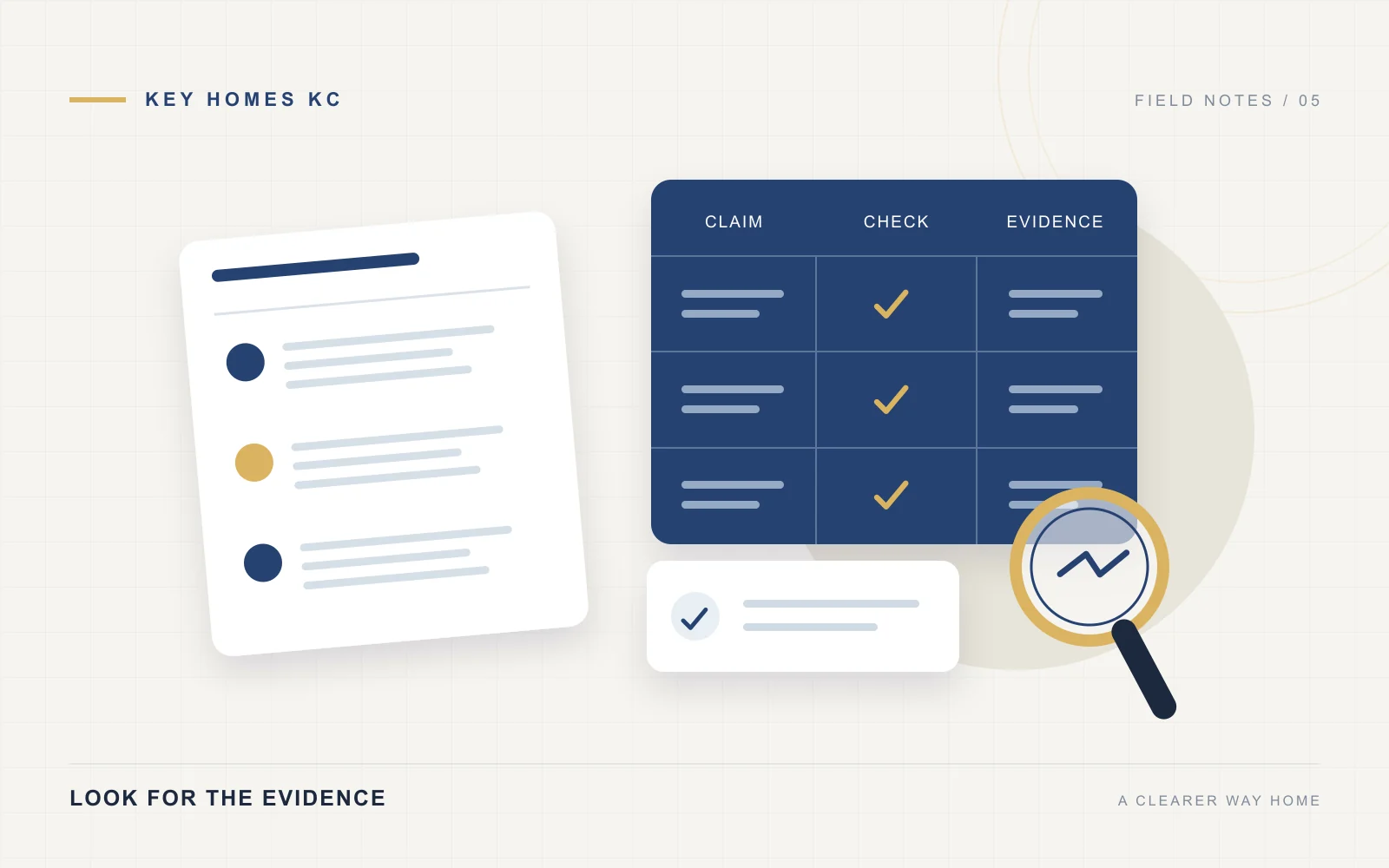
The most useful answer to “Who are the best Realtors in Kansas City?” is a way to evaluate the evidence behind a recommendation. Verify the relevant state license, check any claimed REALTOR® membership, examine what reviews actually describe, and compare the proposed service with your needs. No single ranking or star average establishes the best fit for every buyer or seller.
This is an evidence guide, not a ranked list or an award claim for Key Homes KC. “Best” may mean responsiveness, careful property research, a workable selling plan, or coordination across a complicated move. Define the standard before accepting someone else's ranking as your decision.
Translate “best” into criteria you can inspect
Choose a few claims that would materially affect your decision, such as experience with a comparable property, a published award or a relevant designation. Record the original source, its date and the person/team it describes. A collection of attractive badges is less useful than knowing what each badge actually establishes.
Keep the interview sequence separate from this evidence check. Our agent-selection guide explains how to prepare a brief, interview candidates, and review the agreement. Here, the question is whether a review, credential, ranking, or example actually supports the claim being made.
Read reviews for the work described
A review becomes more useful when it explains the service: communication during a difficult decision, clarity about a contract, organization of a sale, or how an unresolved question was handled. Look for information relevant to your circumstances rather than treating every positive comment as equally informative.
Consider the date, transaction context, and whether the review identifies the professional or team member involved. A detailed account can still describe one person's experience rather than a promise of your result. A lack of detail is a reason to ask questions, not proof that a reviewer is dishonest. Avoid drawing conclusions about authenticity that you cannot support.
| Claim | Check the original source | Limit of the evidence |
|---|---|---|
| Highly rated | Review text, dates, platform and named professional | An average does not identify the work or guarantee your experience |
| Award winning | Issuer's record, year and methodology | Recognition may measure a specific period, survey or team |
| Top local producer | Original geographic scope, time period and individual/team attribution | Volume does not directly measure communication or suitability |
| Special designation | Issuing organization's current record and requirements | A credential is not a separate state license or promised result |
| Relevant transaction experience | Appropriately shareable evidence of role, place and date | A team-wide claim does not establish one person's involvement |
Examine how a ranking was produced
Before treating a list as independent evidence, look for its publisher, date, geographic scope, selection criteria, and any disclosed commercial relationship. Ask whether a placement concerns an individual or a team and what period or activity was measured. If the methodology is missing, treat the list as a lead for further research.
A volume-based ranking does not directly describe communication or your likely experience. A neighborhood label does not establish expertise with every property type in that area. Keep the conclusion proportionate to what the ranking actually measures, and ask the professional to explain how that evidence relates to your move.
Hypothetical example: a top-producer badge and a detailed review
Imagine one candidate displays a metro-wide team-volume award, while another has a detailed review describing the sale of a home with similar constraints to yours. The award may support a team activity claim; the review describes one client's experience. Neither alone answers which individual would handle your work.
Open the award issuer's methodology and record the team, period and geographic scope. Read the review for the named professional, work performed and date. Mark any missing attribution as unresolved. You can then ask targeted questions without turning either limited source into an unsupported best-agent conclusion.
Verify credentials at their source
Use Kansas commission or Missouri commission resources for the individual/company and property state. NAR explains REALTOR? as membership rather than a separate license category. Check a designation with its issuer and keep current status separate from an old biography or logo.
The agent-versus-broker explanation separates license, supervision and representation. Here, record whether a claimed credential was verified, partly supported or remains unanswered; the selection guide handles the interview and agreement sequence.
Ask for local reasoning rather than a local slogan
Check whether local evidence matches the actual location and task. A Missouri transaction does not establish Kansas licensure; a broad metro ranking does not establish experience with a particular property type. A useful example identifies what was researched, which role the person performed and what evidence can appropriately be shared.
Ask for relevant examples while respecting client privacy. A professional can explain a process without disclosing confidential financial information or using a past outcome as a guarantee. If a transaction claim matters to your decision, clarify the date, location, individual or team role, and supporting information that can appropriately be shared.
Create an evidence worksheet
| Claim being assessed | Record to retain | Unresolved question |
|---|---|---|
| License | Commission, individual/company match and check date | Does the status apply to the property's state? |
| Review | Original platform, date, professional and described work | Is the experience relevant to the work I need? |
| Ranking | Issuer, year, geography, methodology and commercial disclosures | What exactly was measured? |
| Membership/designation | Issuer's verification and current status | Does the claim remain current? |
| Transaction experience | Date, location and individual/team role | Does the evidence support the precise claim? |
Keep an unsupported claim in the open-question column until it is resolved. You do not need to turn every criterion into a numerical score; a simple supported, partly supported, or unanswered record can make the decision clearer. Give essential requirements more weight than superficial differences in presentation.
Evaluate Key Homes KC using the same standard
Apply this standard to Key Homes KC too. Request support for any credential, recognition or experience claim that matters to your decision. Use the representation hub to frame a consultation inquiry and confirm the professional and available scope. This article does not verify a company award or recommend Key Homes KC as a ranked winner.
Sources and further reading
Sources checked . Requirements and availability can change; confirm details with the responsible organization before relying on them.
Related guides
Bring your questions and compare the answers
Discuss your property, timing and expectations with Key Homes KC. Ask for a defined next step and the evidence you need to assess fit.